
Unlock Success Matching Your Leadership Archetype to Context
You were a star performer at your last company. A revenue-driving powerhouse who consistently delivered results. Then you took that executive role at a new organization—and suddenly you’re struggling. What happened? How did your successful leadership archetype falter?
The answer might not be about your skills or experience, but your leadership archetype. Many high-performing executives fail not because they lack talent, but because they’re the right leader in the wrong environment.
Based on the Leadership Archetypes Curveball Method, there are four distinct leadership styles that each excel in different organizational contexts. Recognizing your natural style—and knowing when to adapt it—can be the difference between thriving and merely surviving in your leadership role.
Understanding Your Leadership Archetype
The Curveball Method classifies leaders along two key dimensions: risk tolerance (risk-averse to risk-tolerant) and focus orientation (detail-oriented to big-picture oriented). This creates four distinct leadership archetypes:
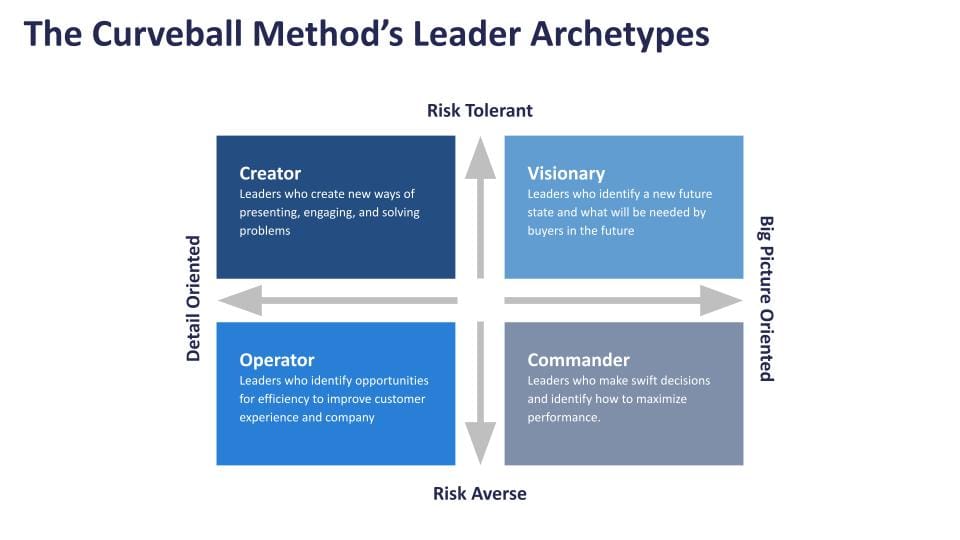
1. The Visionary (Risk-Tolerant + Big-Picture Oriented)
Visionaries identify future states and anticipate what buyers and markets will need before others see it. They excel at:
Creating compelling future narratives
Spotting emerging market opportunities
Rallying teams around ambitious goals
Making bold strategic bets
Examples:
Bill Gates (Microsoft) who envisioned a computer on every desk when computers were still room-sized machines
Reed Hastings (Netflix) foresaw streaming when others were still focused on DVD rentals
Elon Musk (Tesla, SpaceX) consistently pushes boundaries of what’s possible in multiple industries
Sara Blakely (Spanx) reimagined shapewear when no one else saw the opportunity
Jeff Bezos (Amazon) who famously said, “We’re willing to be misunderstood for long periods of time”
Visionaries thrive in startup environments where defining a new future is critical.
2. The Commander (Risk-Averse + Big-Picture Oriented)
Commanders make swift, decisive decisions that maximize performance. They excel at:
Creating clear organizational structures
Setting ambitious but achievable goals
Making tough calls during critical moments
Driving accountability and results
Examples:
Tim Cook (Apple) who has methodically built on Jobs’ vision with disciplined execution
Satya Nadella (Microsoft) transformed the company’s culture and strategy while maintaining stability
Indra Nooyi (former PepsiCo) drove performance while managing complex stakeholder relationships
Mary Barra (GM) navigated the company through major industry shifts with disciplined execution
Andy Jassy (Amazon) scaled AWS methodically while maintaining Amazon’s high standards
Commanders thrive in scaling environments and turnaround situations where decisive action and performance focus are needed.
3. The Creator (Risk-Tolerant + Detail-Oriented)
Creators develop innovative approaches to presenting, engaging, and solving problems. They excel at:
Developing novel solutions to complex problems
Crafting unique customer experiences
Finding creative ways to differentiate products
Breaking established paradigms with fresh thinking
Examples:
Steve Jobs (Apple) obsessed over product details while taking big risks on revolutionary products
Yvon Chouinard (Patagonia) revolutionized how business could align with environmental values
Brian Chesky (Airbnb) reimagined hospitality through attention to experience details
Bozoma Saint John (marketing executive) brings creative approaches to brand storytelling
Virgil Abloh (Off-White, Louis Vuitton) transformed fashion by reimagining established norms
Creators thrive in innovation environments where expanding into new territories is the priority.
4. The Operator (Risk-Averse + Detail-Oriented)
Operators identify opportunities for efficiency to improve customer experience and company performance. They excel at:
Optimizing processes and systems
Building sustainable operational infrastructure
Ensuring consistent quality and delivery
Implementing methodical improvements
Examples:
Steve Ballmer (Microsoft) who focused on operational excellence and scaled Microsoft’s enterprise business
Sheryl Sandberg (Meta) built the operational infrastructure that turned Facebook into a profitable business
Dara Khosrowshahi (Uber) brought operational discipline to a company that needed stability
Susan Wojcicki (former YouTube) methodically grew YouTube while improving content policies
Sundar Pichai (Google) has maintained Google’s core products with steady operational focus
Operators thrive in predictable growth environments where optimization and efficiency drive success.
Finding Your Leadership Archetype
Ask yourself these questions to identify your natural leadership style:
Risk Tolerance Assessment:
When faced with incomplete information, do you prefer to:
Act decisively based on available data (Risk-Tolerant)
Wait until you have more complete information (Risk-Averse)
How do you feel about failure?
It’s a necessary part of innovation and learning (Risk-Tolerant)
It should be avoided through proper planning and analysis (Risk-Averse)
When evaluating opportunities, are you more concerned with:
Missing out on potential upside (Risk-Tolerant)
Protecting against potential downsides (Risk-Averse)
Focus Orientation Assessment:
When solving problems, do you typically:
Start with the big picture and work backward (Big-Picture)
Gather specific details and build upward (Detail-Oriented)
How do you prefer to communicate vision?
Through broad concepts and future possibilities (Big-Picture)
Through specific steps and concrete examples (Detail-Oriented)
What energizes you more:
Thinking about future strategies and possibilities (Big-Picture)
Working through implementation challenges (Detail-Oriented)
Building Complementary Leadership Teams
The most effective organizations leverage diverse leadership archetypes within the Leadership Archetypes Curveball Method. Here’s how to be intentional about building complementary leadership:
Startup Phase: Prioritize Visionaries who can chart the course, supported by Creators who can bring innovative solutions to life.
Scaling Phase: Bring in Commanders who can make tough decisions quickly, supported by Operators who can build sustainable systems.
Established Growth Phase: Lean on Operators to optimize and create predictable growth, with Creators helping to find new opportunities in adjacent markets.
Reinvention Phase: Bring Visionaries back to the forefront, with Commanders helping to drive transformation at scale.
Rather than viewing leadership as a one-size-fits-all approach, the Curveball Method helps us recognize that different phases of business require different leadership strengths. The most adaptable leaders understand their natural style and know when to lean into it—and when to develop complementary capabilities.
The Leadership Archetype Challenge
Few of us are purely one archetype. Most leaders show a primary style with elements of secondary archetypes. The challenge is to:
Recognize your natural strengths and the environments where you thrive
Develop awareness of your blind spots and when they might create vulnerability
Build teams with complementary archetypes to create balanced leadership
Adapt your approach when the organization’s needs shift
What’s your leadership archetype? And more importantly, is it aligned with what your organization currently needs? Understanding these dynamics is the first step toward mastering the leadership curveballs that inevitably come your way.
Explore more?
Tags
Recent Posts
Copyright 2024@gtmflow.com